Do you think any of these solutions are the best 


Showing posts with label patient-testimonials. Show all posts

Share Your Story

Frequently, people learn from the life experiences of their friends, peers, even strangers. When going through the steps for bariatric surgery, patients can take comfort in knowing they are not alone. It helps to find that others have managed their care and want to offer support.

Have you lost weight through weight-loss surgery at Penn, or through diet and exercise? What motivated you to lose weight? What tools did you find most helpful when you were losing weight? Share your story with others, and help them learn from your experiences.

Click here to tell your own story.

As stories are received, they will be posted here so that you may read them to find support and encouragement, and to learn more about bariatric surgery at Penn.

Write Your Own Weight-Loss Story

Penn can help you lose weight.

Learn about medical weight loss in Philadelphia, and the Penn Bariatric and Metabolic Surgery Program at a free information session about weight-loss surgery in Philadelphia.

There, you will hear about your weight-loss surgery options, and how Penn can help you lose weight and get healthy for good.

Register for a free information session today.
reade more... Résuméabuiyad

The Feeling of Full

Chiara Gravell had a sleeve gastrectomy at Penn Medicine with weight-loss surgeon Noel Williams, MD, in 2011. Since then, she’s lost more than 150 pounds, and has gone from being obese to completing triathlons. In this blog, she talks about feeling full, and learning how to make healthy choices.

I get a lot of questions about my experience with weight-loss surgery. A LOT of questions. I am now in most people’s eyes “thin.” I have, in their opinion, “crossed the finish line” and am a “winner” in the battle of obesity.

When I get the questions: “Why did you have the surgery?” or “Why didn’t you just do what you are doing now, before and lose weight on your own?” My answer is short and sweet and leaves most people scratching their heads. My answer is, because of the miracle of full!
Pre weight-loss surgery, I was hungry all of the time. I thought this was normal. I thought everyone had to control their ravenous hunger all of the time. I thought people were like me, when eating a normal sized meal; they were still hungry at the end.


When people would claim “Oh I am stuffed” or “I can’t possibly eat another bite” I would think secretly that they were over dramatic. Can’t eat another bite - really?

Then I had my sleeve…. And the MIRACLE of FULL happened to me. When I was about three or four months out, I had this feeling in my chest. It was constricting, uncomfortable and made me sleepy and annoyed all at the same time. Ok, I am actually the dramatic one I thought I was dying and having a heart attack.


I called the nurses at Penn Medicine’s Weight Loss Center, to describe the horror I was feeling. The answer came back, “That is the feeling of full Chiara. Take a bite or two less next time you eat.”

Uh??? What did she just say? Full? I must have looked like Scooby Doo with a very confused look on my face.

I started to follow the new instructions of the nurses, when I started to feel that constriction in my stomach or chest and I stopped eating. During the first year or so after surgery this feeling came anywhere from two bites to eating one-cup of food. I stopped waited a few minutes and then proclaimed in reality that “I couldn’t eat another bite.” It was true I couldn’t.

I had NO IDEA other people felt this way. I never did before surgery. I could eat a 16 oz steak without blinking and still eat all of the sides and never feel “full.” When I share this with others they say not even after Thanksgiving dinner did you feel full? The honest answer is NOPE! (as evidenced in my before picture here)


It has been 26 months since I have had surgery. I now have that signal in my head, “Chiara stop eating you are done.” I now have to obey it on my own. The sleeve did it for me for about 18 months. Now I have to stop when I am full. However, I am FULL! I can feel the FULL!

When people said to listen to my body before the surgery, I did. I listened it just wasn’t talking. Today I listen and “obey” the signals. This is the real miracle of weight-loss surgery for me. It has given me a tool that I can use long term, (that most people have naturally – I didn’t) to manage my weight. (as evidenced in this picture taken last week)


Lose Weight at Penn Medicine

Penn can help you lose weight.

Learn about medical weight loss in Philadelphia, and the Penn Bariatric and Metabolic Surgery Program at a free information session about weight-loss surgery in Philadelphia.

There, you will hear about your weight-loss surgery options, and how Penn can help you lose weight and get healthy for good.

Register for a free information session today.
reade more... Résuméabuiyad

Gift Guide for Bariatric Patients

Kathryn Naphy is a mom of two who’s maintained her 100+ weight loss since 2006, when she had weight-loss surgery with Matt Kirkland, MD, bariatric surgeon at Penn Medicine in 2006. In this blog, she shares some of her gift ideas for those who’ve had weight-loss surgery.

Read more about her story here, join her on her blog, Eating After Gastric Bypass or follow her on Twitter. Also, learn more about weight-loss surgery at Penn Medicine at a free information session.


Happy holidays to the bariatric patient!

The holidays are right around the corner, and chances are there’s someone on your list this year that’s had weight-loss surgery or is preparing for surgery. There are some very obvious high calorie food gifts that are a no-go for your bariatric friend but what kind of stuff do they really need? Here are some suggestions your friend or loved one will really appreciate for his or her post-op life.

  • Dishwasher-safe water bottles
  • Gift certificate for clothing-- their clothing size will be changing…a lot!
  • Gift basket with whey or soy protein powder samples
  • Complete multivitamin and mineral supplements, or a gift certificate for vitamins
  • Shaker bottle for protein shakes
  • Kitchen supplies, such as a set of measuring cups and spoons, food scale, or pre-measured food containers holding 2 – 4 oz.
  • An attractive insulated lunch box or Bento boxes for meals on the go.
  • iTunes gift card for rockin’ workout songs
  • Bariatric or low fat/low calorie cookbook
  • Get physical! Exercise is a big part of our post-op lives, so if your loved one has been eying up a some exercise equipment for the home or a gym membership or thinking about taking up a sport like tennis, maybe a gym membership or a lesson would be a welcome gift. Also consider a fitness tracker such as the Fitbit, Nikefuel band or Jawbone.

Please skip: Candy, alcohol (no alcohol is permitted for a year after surgery), holiday cookies, fruit cake, etc. It will end up going to waste or have to be re-gifted.

All in all, the focus is still on thoughtful gift giving and the above gift suggestions will be very welcome to your pal post bariatric surgery!

Happy Holidays!

Lose Weight at Penn Medicine

Penn can help you lose weight.

Learn about medical weight loss in Philadelphia, and the Penn Bariatric and Metabolic Surgery Program at a free information session about weight-loss surgery in Philadelphia.

There, you will hear about your weight-loss surgery options, and how Penn can help you lose weight and get healthy for good.

Register for a free information session today.
reade more... Résuméabuiyad

My Recipe Makeover: Velvety Butternut Squash Soup

Kathryn Naphy is a mom of two who’s maintained her 100+ weight loss since 2006, when she had weight-loss surgery with Matt Kirkland, MD, bariatric surgeon at Penn Medicine in 2006. In this blog, she shares some of her gift ideas for those who’ve had weight-loss surgery.

Read more about her story here, join her on her blog, Eating After Gastric Bypass or follow her on Twitter. Also, learn more about weight-loss surgery at Penn Medicine at a free information session.


Velvety Butternut Squash Soup

Ingredients
  • 4 cups chicken stock
  • 4 cups butternut squash, cut in cubes
  • 3 large carrots, chopped
  • 1 small onion, diced
  • 5 stalks celery, diced
  • 1 clove garlic, minced
  • 1 teaspoon curry powder
  • 1/4 teaspoon ginger
  • 1/8 teaspoon cinnamon
  • 1 – 5 oz can evaporated milk
  • 1 Tablespoon olive oil
  • Salt
  • Pepper
Directions
  1. Spray a large baking sheet with vegetable oil. Arrange squash and carrots on the baking sheet.
  2. Roast squash and carrots in a preheated 425-degree oven for 20 minutes.
  3. In a large stock pot. Saute onion, celery and garlic in 1 tablespoon of olive oil over medium heat for several minutes.
  4. Stir in spices, and cook 1 minute longer; remove from heat. Add roasted squash and carrots to the stock pot.
  5. Add in broth, and evaporated milk cover, and cook over low heat about 20 minutes. Working in batches, run soup through a blender, or use an immersion blender until smooth.
  6. Serve soup (about 1 1/2 cups per serving) Garnish with a dollop of Greek yogurt and pumpkin seeds.
Tip from Kate: I always stir in some unflavored protein powder into my portion when I make soups!

Yield: 6 servings
Serving size: Approximately 1 1/2 cups
Nutritional Information: Each serving contains approximately 170 calories, 6g fat, 8g protein, 12g sugar.
Original Recipe by Better Bariatric, LLC

reade more... Résuméabuiyad

Are You Ready for Some Football?

Chiara Gravell had a sleeve gastrectomy at Penn Medicine, with weight-loss surgeon Noel Williams, MD, in 2011. Since then, she’s lost more than 150 pounds, and has gone from being obese to completing triathlons. In this blog, she talks about her love of football, and the habits she’s changed to stay in the weight-loss game. Learn how you, too, can lose weight at Penn Medicine.

It is my favorite time of year, September through February. Some people call it Fall, some people the “holiday” season. I call it FOOTBALL!

In my teenage years I fell in love with football watching the Bears games with my Dad on Sundays. I could sit and watch TV for three whole hours without being bugged while eating football snacks. (usually potato chips and sandwiches). It was “Totally Awesome!”


As time progressed; my football Sundays became more elaborate. Lots of friends, and family and a lot more food! Wings, nachos, 5-foot long subs, chili, burgers, chips, dip, etc. I would watch at least two out of the three Sunday games and eat. Then there was football on Thursday and Monday nights. I was eating food that had thousands of calories and little to no national value and not getting any exercise.

That was then….

One of my biggest fears about weight-loss surgery was, “How am I going to handle football?” Well two years out from sleeve gastrectomy surgery, I still love football. I still watch it on a regular basis but with some significant modifications to the type and quantity of food I eat during the game.

Right after surgery I could only drink my protein shakes and didn’t want anything more. I progressed to low-fat string cheese or shrimp with cocktail sauce. This worked as I could pick at it throughout the game.

The following Fall, I had started to really exercise, and began to participate in distance races. On football Sundays, I needed to train for 90 minutes to two hours. Again my fears kicked in, how am I going to do all of these races (which are also on Sundays) and watch FOOTBALL?

The answer was so simple. I had heard it a thousand times, from diet programs, the nutritionists at the Penn Medicine Weight Loss Center, my Mother, and others. The answer was plan, plan, and plan!! “If you fail to plan you are planning to fail,” is a mantra in my life.

Now I get up early and do a long work out (anywhere from 1 ½ hours to 2 hours) then come back home ready for FOOTBALL. Also all of the races are in the morning, so I can be back and in front of the TV by 1 pm for the first game.

The food on football Sundays also has changed. I eat vegetables, lots of them, with low-fat dip like Greek yogurt that tastes like ranch dressing.) I also don’t eat all day. I have my lunch and dinner watching football but that is it. I don’t “snack” unless it is raw veggies. My husband, who does most of the cooking in our house, started making vegetarian chili for football. If there are chips with the chili, they are organic, gluten free, and veggie based versus the traditional flour based.

The last thing I added was more movement. You would think a race or two hours of working out would let me “deserve” an eight-hour stint in front of the TV on the couch. Nope! I walk around the house during commercials. I walk outside during commercials. I take out the trash, or clean the kitty litter, do the dishes, sweep the floor, whatever… if there is a commercial I am up and moving!

So now I can BEAR DOWN and let the EAGLES FLY all day every Sunday! I can enjoy the games, the company of friends and family. I don’t have to gain weight, by eating myself into an eight-hour food coma on the couch.

Are you a football fan like Chiara? How has game day changed for you? What tips would you offer others?

Lose Weight at Penn Medicine


Penn can help you lose weight.

Learn about medical weight loss in Philadelphia, and the Penn Bariatric and Metabolic Surgery Program at a free information session about weight-loss surgery in Philadelphia.

There, you will hear about your weight-loss surgery options, and how Penn can help you lose weight and get healthy for good.

Register for a free information session today.
reade more... Résuméabuiyad

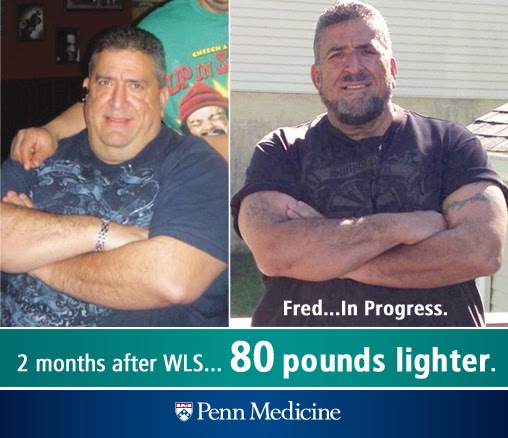
93 Pounds Down And Counting After Weight-Loss Surgery at Penn

Fred Jiminez knows a thing or two about how to build the perfect body. As a competitive power weight lifter for three decades, Fred knew what to put into his body in order to achieve maximum strength and performance.

“I was extremely competitive,” he remembers. “I ate very healthy with a lot of protein, and was dedicated to working out. I weighed 275 pounds, but I was all muscle.”

But 15 years ago, things changed. Fred stopped eating well and working out. He fell into a sort of depression and a pattern of poor eating habits and not enough exercise.

“I was getting heavier and heavier,” remembers the Belmawr, NJ resident. “It was hard to keep up with the girls I was coaching through my softball pitching clinic, and I began having health problems creep up like high blood pressure and sleep apnea.”

Fred tried every diet – Weight Watchers, The Cabbage Soup Diet, Atkins – he even mixed and matched diets to try to make them work for him, but nothing worked long term.

Then, Fred fell. He couldn’t get back up.

“I laid on the ground, not able to get my 472-pound body up off the floor, and I thought long and hard about where my weight had led me, and how I needed to reverse this cycle I was in.”

Fred knew he needed to make a change, but it wasn’t until he met Bruce Sachais, a Penn physician who had weight-loss surgery, that he decided to learn if weight-loss surgery was right for him.

“I met Bruce through the softball clinic, and I hadn’t seen him in a while. When I did see him, he’d lost so much weight I hardly recognized him. It was Bruce that really helped me take the first step,” says Fred.

Taking the First Step

Fred went to a free information session at Penn Medicine in February, and after speaking with his surgeon, Noel Williams, MD, director of the Penn Metabolic & Bariatric Surgery Program, Fred was scheduled for a vertical sleeve gastrectomy.

“I felt like this was the right thing for me, but at the same time,” says Fred. “I know this is a tool and not a quick-fix strategy. For me, I needed to give myself a no-option way of life. I knew this surgery would change the way I would live forever.”

Fred began his weight-loss surgery journey by meeting with a team of physicians including cardiologists, pulmonologists and, of course, members of the bariatric surgery team at Penn including his surgeon, nurses, dietitians and psychologists.

“Everyone was amazing and made me feel like part of the team,” says Fred. “There were no surprises, and I everyone was always on the same page. It was a great feeling knowing I was in their care.”

Fred had surgery on July 18, and soon thereafter, began to see the weight come off – and his health come back.

“In the first month, I lost almost 70 pounds,” says Fred. “I completely changed the way I eat and look at food.”

Fred also was able to stop taking his blood pressure medication, and started exercising again.

“I’ve followed my team’s instructions to tee, and the weight just was melting off,” says Fred. “Weight-loss surgery has changed my perspective on everything I eat. I used to have six eggs for breakfast every morning, and now I am totally satisfied with some yogurt, or one egg. I never want to go back to the way I used to be.”

To date, Fred has lost 93pounds, and continues to lose. He is no longer on medications, and no longer needs his CPAP machine to sleep.

“I have five grandchildren and I want to see them have children,” says Fred. “I feel like I’ve already added 20 years to my life.”

Lose Weight at Penn Medicine

Penn can help you lose weight.

Learn about medical weight loss in Philadelphia, and the Penn Bariatric and Metabolic Surgery Program at a free information session about weight-loss surgery in Philadelphia.

There, you will hear about your weight-loss surgery options, and how Penn can help you lose weight and get healthy for good.

Register for a free information session today.
reade more... Résuméabuiyad

Kathryn Lost More Than 100 Pounds With Penn Medicine

To see Kathryn Naphy, you’d think she’s been thin and eating healthy, balanced meals all her life. But, the 33-year-old mom of two has a story behind what you see today.

“In 2006, I was diagnosed with pre-diabetes, my cholesterol was about 350 and my triglycerides were in the thousands,” remembers Kathryn. “I was only 26, a new mom and I was scared I wouldn’t be around to see my son grow up.”

Though Kathryn had been active her whole life, her weight had always been a struggle for her. Even while eating well and playing sports, she remained about 30 pounds overweight.

“After I had my first child, I hit my highest weight - about 240 pounds,” she remembers. “That, combined with learning about my health problems was a wake up call for me.”

Making the Weight-Loss Surgery Decision

Kathryn’s aunt had Roux-en-Y (gastric bypass) surgery with Penn bariatric surgeon Matt Kirkland, MD, and successfully lost weight – and gained her life back.

“Seeing my aunt’s success made me realize weight-loss surgery might be a tool I could use to get healthy again,” says Kathryn. “My aunt paved the way for me, and everyone in my family was supportive of my decision.”

Kathryn met with Dr. Kirkland to learn about her weight-loss surgery options at Penn.

“I knew gastric bypass was the surgery that would save my life.”

Kathryn fulfilled the necessary testing and nutrition requirements, and had her surgery
On July 5, 2006. Everything went smoothly.

“The biggest challenge was immediately after surgery,” remembers Kathryn. “It was difficult to lift my son in and out of the bathtub while I was recovering, but aside from that, my recovery was fairly easy.”

It wasn’t long before Kathryn lost more than 100 pounds going from her pre-surgery weight of 224 to 119 pounds.

“I was surprised at how fast the weight just came off,” she says. “In fact, I had to make a conscious effort to stop losing weight because I was getting so thin.”

Kathryn worked with Penn dietitians to maintain an eating program that would help her maintain her weight at about 130 pounds.


Pregnancy After Gastric Bypass Surgery

And then in 2009, she got pregnant with her second child. This pregnancy, she says, was a bit different than her first.

“I didn’t eat poorly like I did with my first pregnancy,” she says. “And I only gained 35 pounds. Overall, this pregnancy was easier because I wasn’t carrying all of that extra weight around.”

Kathryn breastfed and got back on track after she gave birth, and returned to her pre-pregnancy body in no time.

Today, Kathryn blogs about her weight-loss journey, and what it’s like to be a mom of two who’s had gastric bypass surgery.

She has also led by example, and changed the way her entire family eats by cooking fresh meals prepared with fruits, vegetables, lean meats and whole grains.

“I still eat small meals, five or six times a day,” she says. “Weight-loss surgery at Penn was the tool I needed to change my life and turn my health around for good.”

Connect with Kathryn on her blog, Eating After Gastric Bypass, or follow her on Twitter

Lose Weight at Penn Medicine

Penn can help you lose weight.

Learn about medical weight loss in Philadelphia, and the Penn Bariatric and Metabolic Surgery Program at a free information session about weight-loss surgery in Philadelphia.

There, you will hear about your weight-loss surgery options, and how Penn can help you lose weight and get healthy for good.

Register for a free information session today.
reade more... Résuméabuiyad

Half Her Size! From Obese to Triathlete

Chiara Gravell is about to compete in her fourth triathlon.

While it's an achievement in itself, it’s an even greater achievement because just 2 years ago, Chiara weighed nearly 300 pounds.

“I had always been heavy, and up and down on the scale for most of my life,” says the Delaware resident who at one time, lost 100 pounds. “Even though I was always athletic, I could not lose weight and maintain my loss.”

Determined to succeed, Chiara made an appointment with Penn weight-loss surgeon Noel Williams, MD.

“I was committed to make this work, and we decided the sleeve gastrectomy, or gastric sleeve surgery, was the right procedure for me,” says Chiara.

During a sleeve gastrectomy, a sleeve-shaped tube is created from a small portion of the stomach and the majority of the stomach is removed. Food passes through the new stomach tube directly into the intestines. Nutrients and calories are absorbed from food normally, but patients feel full sooner and longer.

Sleeve gastrectomy can be a permanent surgical solution to manage weight. A second operation may be required, however, if significant weight loss is required to improve the patient's health.

But before she could have the surgery, Chiara would have to go through routine medical testing that included a sleep study, cardiovascular exam, and a physical exam.

“Fortunately, there were no issues yet,” says Chiara. “I was a pretty healthy 300-pound woman.”

Big Changes, Healthier Life Ahead

Sleeve gastrectomy is performed laparoscopically and, as was Chiara’s case, can be performed via robotic surgery.

Chiara had the surgery in September, 2011.

“Nine weeks after the surgery, my husband and I flew to Europe for a vacation,” says Chiara. “It was the first time in a long time I could fly and buckle my seat belt without an extender.”

Chiara and her husband spend 3 weeks in Europe. As you can imagine, they did a lot of walking… and eating.

“The first thing I noticed during our vacation was that I could walk for hours without my feet hurting,” she remembers. “I thought everyone’s feet were supposed to hurt, but it was my weight that made walking so difficult for me in the past.”

Chiara also learned how to travel and eat out with her new nutrition requirements.

Chiara finishing a race!
“I ate what I would normally eat while not on vacation, but just had much smaller portions,” she remembers. “I would only eat about ¼ of what was given to me.”

Chiara lost weight on that trip, and continued to lose weight. She soon discovered running and began to compete first in 5k races, then a 10k, ½ marathons and now, triathlons.

“I connected with other people who have had weight-loss surgery and compete in races through Facebook, and we all support each other,” says Chiara. “Racing keeps me motivated to keep working out.”

Today, having lost 150 pounds, Chiara is literally half her size, and she continues to lose weight.

“Surgery is a weight-loss tool,” says Chiara. “Go to an information session, learn all of your options, and stay committed to a healthier lifestyle.”

Lose Weight at Penn Medicine

Penn can help you lose weight.

Learn about medical weight loss in Philadelphia, and the Penn Bariatric and Metabolic Surgery Program at a free information session about weight-loss surgery in Philadelphia.

There, you will hear about your weight-loss surgery options, and how Penn can help you lose weight and get healthy for good.

Register for a free information session today.


reade more... Résuméabuiyad

Down 120 Pounds - Off Medications For Good

For Gerry Pernot of Scranton, PA, it was an impromptu conversation with a nurse at his cardiologist’s office that got him thinking about weight-loss surgery.

The father of three was in for a stress test, and as he discussed his weight losses and gains throughout his life, the nurse working with him told him she recently had weight loss surgery at Penn Medicine.

“At the time I was on diabetes, cholesterol and acid reflux medications,” remembers Gerry. “Listening to this nurse talk about how weight-loss surgery changed her own life inspired me to get more information myself.”

Losing Weight For Good

Gerry began his weight-loss journey in December, 2011. “I went to an information session, and soon had my first appointment with Dr. Korus,” says Gerry. “That kick-started my journey to where I am today.”

Gerry completed the required tests and screenings prior to gastric bypass surgery.

“Everyone I came in contact with from the sleep study technicians to the pulmonologists and the nutritionists were fantastic,” says Gerry. “I couldn’t have asked for a more trusted or friendly team of experienced professionals to work with.”

Gerry began his medical weight management program (a requirement before surgery) where he worked with the Bariatric Surgery’s nutrition team to lose 40 pounds.

Gerry had gastric bypass surgery with Dr. Korus December 2012, and since then, he has lost 80 pounds more for a total of 120 pounds lost with Penn Medicine.

“I just visited my primary care physician for a check up,” says Gerry, “and my blood work is text book normal! I am no longer on medications for diabetes and cholesterol, and I feel like a completely different – healthier – person.”

Overcoming Eating on the Go

Gerry says one of the biggest challenges has been eating on the go. Gerry travels a lot for work, and now finds himself preparing food he can take with him.

“I bring protein shakes with me as an emergency,” says Gerry. “It can be challenging to find something healthy to eat when you are in a new city for business, especially if I get in late and things are closed.”

One thing Gerry likes to do when he does arrive in a new city, is visit the local grocery store where he can stock up on healthy foods for his hotel room.

“This way, I know that I always have healthy foods for myself so I don’t have an excuse to eat poorly,” he says.

Gerry adds that after years of losing and gaining weight, this weight loss is for good.

“I recently red Al Roker’s book, Never Goin’ Back, and I really do believe that this time, I am never going back,” says Gerry. “I feel better than I ever have; I am in control.”

Lose Weight at Penn Medicine

Penn can help you lose weight.

Learn about medical weight loss in Philadelphia, and the Penn Bariatric and Metabolic Surgery Program at a free information session about weight-loss surgery in Philadelphia.

There, you will hear about your weight-loss surgery options, and how Penn can help you lose weight and get healthy for good.

Register for a free information session today.
reade more... Résuméabuiyad

150 Pounds Gone with Penn Medicine

It was a day that was supposed to be filled with joy and excitement for her granddaughter, who was graduating from Junior high school. For Robyn Irving, it was a joyous day, but it was also one that was filled with embarrassment.

“I was in the auditorium, looking for a place to sit that would accommodate my 397-pound body,” remembers Robyn. “I attempted to squeeze into one of the seats, but was unable to fit. I felt so embarrassed. A member of the school staff placed an armless chair in the back of the auditorium for me. There I sat far away from the graduation program barely able to see and hear my granddaughter at such a proud moment in her life."

A week later at a routine check-up, Robyn’s family physician told her she was borderline diabetic, and that her blood pressure was extremely high.

“That diagnosis scared me,” she says. “I knew I needed help. I wanted to live.”

Advice From A Friend

Robyn’s co-worker had gastric bypass surgery at Penn Medicine, and offered her advice and support when Robyn asked her about her experience.

“After that conversation, I made an appointment for a consultation with Dr. Williams, who felt I was a good candidate for gastric bypass surgery,” she says.

Robyn struggled with her weight most of her life. She tried popular weight-loss programs and even diet pills. “I would always get off to a great start,” she notes, “but then I would just gain the weight back plus more.”

With the support of her primary care physician, Robyn began her journey to heath.

Bypass: Before and After

At 58, Robyn was 397 pounds and was wearing a size 6X in scrubs that were specially ordered for her at her job at Children’s Hospital of Philadelphia.

But it wasn’t the size of her clothing or number on a scale she set her sights on, it was the seat belt in her car.

“At almost 400 pounds, I couldn’t fasten it,” she says. “It was a daily reminder that my weight was not only a health concern, but a safety one as well.”

Robyn had gastric bypass surgery on January 9, 2012, and since that date, she has seen many milestones.

"I am so grateful to have had a wonderful team of nurse practitioners, and nutritionist who helped me through every milestone that waited ahead of me," says Robyn.

“So far, I have lost 150 pounds, my pre-diabetes status is gone, and my blood pressure is normal,” she says. “I take great delight at being able to buckle my seat belt in my car now.”

Robyn also enjoys taking Zumba classes, walking, line dancing and working out at the gym with her daughter.

“I’ve discovered new foods too,” she says. “Spaghetti squash is one of my favorite things to make. I just cut up some chicken breast to have with it, and throw some low sodium tomato sauce on top for a great meal. Learning to shop and read labels at the supermarket has been a great experience also.”

Everyone is proud of Robyn, including her granddaughter whose graduation ceremony inspired the healthy lifestyle change.

“I had great support teams from my family, friends and church family who encouraged me and cheered me on when I needed that extra push to stay in it to win it. I shared my story in church and was able to show them my journey from the 6X scrubs,” says Robyn.

“Thank You Penn Medicine. I am blessed to have had the chance to change my life and find health again.”

Lose Weight at Penn Medicine

Penn can help you lose weight for good. 

Learn about medical weight loss in Philadelphia, and the Penn Bariatric and Metabolic Surgery Program at a free information session about weight-loss surgery in Philadelphia.

There, you will hear about your weight-loss surgery options, and how Penn can help you lose weight and get healthy for good.

Register for a free information session today.
reade more... Résuméabuiyad

Trading in a Food Addiction for New Addiction

Lisa Harris of Clementon, NJ, was a self-proclaimed “yo-yo” dieter her whole life. Moved by her father’s dying request to get healthy, Harris had gastric bypass surgery at Penn Medicine with Alan Shuricht, MD, FACS.

There are a few side effects to weight-loss surgery. Fortunately, I’ve been lucky and haven’t had a single medical issue due to my surgery.

But I have had a few, non-medical side effects. Here are some of my side-effects from weight-loss surgery.

Brrr! Feeling Cold After Weight-loss Surgery

One major problem that I deal with nearly every day is simple. I’m COLD.

I no longer have 163 lbs of warm, insulating fat surrounding my bones. Now, if I’d taken 5 or 10 years to lose that weight, my brain might have been able to keep up. But after dropping this amount of weight in just over a year, the neurons are misfiring all over the place. My “normal” body temperature is now 96.7 degrees. I sit outside in the summertime wearing long sleeve shirts. Sweaters are year-round attire for me in my office. Air conditioning in the summer is like putting me in a meat locker, and I have to go outside to thaw out. My employer forbids space heaters, but I found a way around that rule: I have a heating pad. Nobody ever says anything to a woman with a heating pad in her lap!

My Shoe Addiction

My brain is broken in another sense as well. An earlier blog post mentioned transfer addiction. Transfer addiction is when you trade one addiction (food) for another.

While I haven’t turned to drugs or alcohol, my habit can be just as expensive. It’s shoes. I’m drawn to shoe stores and shopping for the latest and greatest style has become my new pastime. I have always had an addictive personality. I am a former smoker having started at age 17. I quit cold turkey in 2006, after a beloved aunt was diagnosed with lung cancer. I am formerly morbidly obese, and I kind of quit food too in a way…. This after my dad’s dying wish for me to lose weight.

But nobody ever died from shoe shopping, right?

Does running to the clearance rack count as cardio? Absolutely! You should see my collection. My closet has spilled into my bedroom, complete with racks to hold shoe boxes.

I may make light of transfer addiction, but for some of us, it can come at a steep price. Know your limits, and know your boundaries. If you feel the need to turn to drugs or alcohol, don’t be afraid to ask for help. There are plenty of qualified therapists and counselors available to guide us to the healthiest life imaginable.

The Best Side Effect from Weight-loss Surgery

Since my surgery in 2011, I’ve lost 163 pounds. I feel healthy. I sleep better, am no longer borderline diabetic, and have gone off all of my blood pressure medications.

I’m the happiest and healthiest I’ve ever been. And I have Dr. Schuricht and Penn Medicine to thank for that!

Lose Weight at Penn Medicine

Penn can help you lose weight.

Learn about medical weight loss in Philadelphia, and the Penn Bariatric and Metabolic Surgery Program at a free information session about weight-loss surgery in Philadelphia.

There, you will hear about your weight-loss surgery options, and how Penn can help you lose weight and get healthy for good.

Register for a free information session today.

If you are concerned about addiction, Penn can help. Learn more about addiction treatment at Penn.
reade more... Résuméabuiyad

4 Inspirational Weight-loss Stories from Penn

When it comes to losing weight, the hardest part is usually taking the first step and committing to a program. Finding the inspiration for weight loss can be as easy as listing the reasons and people your weight loss will impact.

Reasons to Lose Weight:

For Your Health

Obesity, unhealthy eating habits, and lack of physical activity can have a huge impact on your health, putting you at a higher risk for type 2 diabetes, high blood pressure, high cholesterol, coronary artery disease, stroke, sleep apnea, and hormone/fertility imbalances. Since waist size affects health problems, focusing on losing weight, especially in your midsection, can greatly reduce your risk of getting these conditions.

For Your Kids

Do you quickly run out of breath while playing with your kids? Have a hard time keeping up with them in general? Losing weight can mean longer, more fun trips to the park, zoo, etc. Not only is staying healthy important to keep in pace with your energetic kids, but promoting healthy lifestyle choices is key to teaching your kids healthy habits to last a lifetime.

For Your Spouse

Remember that line in your wedding vows, “’til death do us part?” Your significant other wants you around for a long, long time. Staying motivated to get in shape is even better when done together – set a goal and help keep each other inspired and on track!

For An Important Event

Class reunion? Summer vacation at the beach? Your wedding? Whatever the reason, getting into a smaller size for an upcoming event is great motivation because it helps you stick with short term goals while creating long term healthy habits.

For YOU

There’s no better inspiration for weight loss than making you feel good about yourself. Not only will weight loss improve your physical health, it improves self esteem, mood, and gives you a fantastic feeling of accomplishment when you meet your weight loss goals.

What’s your inspiration for weight loss?

Read Stories About People Who’ve Lost Weight and Gained Health at Penn

Jackie Savoy lost 150 pounds, got off her hypertension medications and stopped suffering from sleep apnea.


Bruce Sachais lost 121 pounds, but gained more energy because his blood pressure went back to normal and began sleeping better due to improved sleep – without interruptions from sleep apnea.


Lisa Harris lost 160 pounds, and now is pain-free who no longer uses a cane to walk, or feels like health restrictions keep her from doing the things she loves. Lisa is a regular blogger on this blog, and recently wrote about a very important trip she took - and the proud accomplishment that came with it.


Susanne Johnson is a 20-something woman from Philadelphia who had lap-band surgery. Also a regular blogger, Susanne recently wrote about the number that changed her life

Lose Weight at Penn Medicine

Penn can help you lose weight for good. 

Learn about medical weight loss in Philadelphia, and the Penn Bariatric and Metabolic Surgery Program at a free information session about weight-loss surgery in Philadelphia.

There, you will hear about your weight-loss surgery options, and how Penn can help you lose weight and get healthy for good.

Register for a free information session today.
reade more... Résuméabuiyad

307

Susanne is a 20-something nurse who had lap-band surgery at Penn in 2012. In this blog post, Susanne discusses her lifelong struggle with weight, and the decision she made to have weight-loss surgery at Penn.

You can read more about Susanne on her blog, Read Purl Before Swine


Few people feel good about themselves in winter - especially in January when you are acutely aware of the softness that has developed around your middle. Those aren't merely "love handles," they're the red flags calling "FOUL" on all those naughty plays you've been executing at the dinner table.

They're the extra pounds that have been accumulating since the first pass of your hand through the bowl of candy intended for trick-or-treaters, right on through Thanksgiving pie, Christmas cookies, and New Year's Eve champagne cocktails.

In January of 2011 I found myself at my doctor's office for a check-up only to receive a fright that might have been better reserved for Halloween. The scale was clearly not correctly calibrated. Surely, I was not 307 pounds. That was a number usually reserved for contestants on The Biggest Loser!
307 is not a "whoops I ate too much this holiday" number. 307 was the culmination of 20 years of bad eating habits, of consoling myself with sugar and fat, of eating in secret, of 2 attempts at Weight Watchers and countless other fad diets, and plus-sized clothing.

It was also the result of taking high doses of steroids for 6 months after being diagnosed with an auto-immune kidney disorder that had come out of left field earlier that fall. My physician was minimally empathetic, telling me that individuals were capable of managing their weight while on steroids and that I could hardly use my medication regimen as an excuse. Devastated seems too soft a word for the feelings I had at the time. Rock bottom feels appropriate though cliche.

A Struggle

I didn't consider it an option to remain at that weight. As a nurse, I knew all too well that I was already at risk for any number of lifestyle-related illnesses: hypertension, diabetes, cardiac disease, sleep apnea and on. I also knew that I felt out of step with all of my friends who enjoyed active lives that included running marathons and hiking. I felt that I might as well be standing at the bottom of Mt. Everest without any climbing gear.

I was 25 years old and had gotten myself into a royal mess.

I had considered bariatric surgery almost 2 years prior to this incident in my doctor's office but my insurance coverage at the time was not covering any of the available procedures. In my disappointment, I talked myself out of the option and told myself that I would lose weight the "natural" way. The "natural" way has always been considerably difficult for me. I would put in a great deal of effort in changing my eating habits, reducing my calories, and sweating at the gym for very little reward. One pound here, another there, but there was never any dramatic decrease in pounds. Eventually, I would become discouraged eating so little food, counting every calorie, and agonizing over whether or not I could get away with 30 minutes at the gym or if I should push myself for a full hour.

Maintaining a very strict diet was hard at 25 when socialization is focused mainly on food and alcohol. No one wants to go out with friends and sip water. In February, I started my first nursing job and more or less put my weight struggles aside. I was able to stop taking the steroids later that spring and a minimal amount of the weight came off without any intervention, but I was still hovering between 290 and 300. In August, I had a frank discussion with both my primary care doctor and my kidney specialist. We discussed bariatric surgery and I felt ready to pursue the option, especially now that I had an insurance carrier that was willing to approve the procedure.

Preparing to Change for Good

I decided that the laparascopic gastric band was the most appropriate surgical option for me. I found the staff of the bariatric surgery clinic at Penn Medicine to be extremely encouraging and supportive of my choice. I spent 9 months with them before the procedure. I might have much preferred to get the results I craved right away but I now appreciate the months I spent going to the support group meetings, improving my knowledge of nutrition and exercise, and the thorough medical assessments needed to ensure my health and safety.

My surgery was completed in May 2012 and I am learning to use this new tool that I have to manage my weight. It felt like such a relief to know that I now had help in achieving my goals. It is still difficult to change my habits and behaviors but my changing shape and increased endurance motivate me to continue to live a healthy and active lifestyle. It has been exciting to fit into clothes that I hadn't worn in over a year and to buy smaller sizes from my favorite stores.

On a recent trip, I no longer needed a seatbelt extender on the airplane and I didn't feel that I was smothering my neighbors. I started a running program and marvel at my new capabilities in the gym. Even though the scale doesn't always show me dramatic results, I know that I have lost inches in places where I lost fat and gained muscle. For the first time, I am excited about continuing this weight-loss journey. I finally know that I am capable of success.

This winter, I look forward to feeling better about myself even after the holidays are over, to being in more pictures, and to bundling up because I am cold not because I am trying to hide my body.

Learn More About Weight-loss Surgery at Penn

Penn can help you lose weight, and get back to a healthier lifestyle.

Join us for a free information session abut weight-loss surgery at Penn. Meet Penn weight-loss surgeons, and learn what weight-loss options are available to you.

Register for a free information session today.
reade more... Résuméabuiyad

I'm Running a 5K in 2013

Susanne is a 20-something nurse who had lap-band surgery at Penn in 2012. In this blog post, Susanne discusses her one goal for 2013, and how she is planning on achieving it.

You can read more about Susanne on her blog, Purl Before Swine.

My goal for 2013? Run a 5k.

I know, ambitious, right? I’ve been working with a personal trainer at my local gym since August and I feel pretty strong these days. Not necessarily skinny, but strong and capable. I felt that I had accomplished quite a lot just by sticking to my weekly meeting with my trainer for 6 months and I was getting bored with my cardio routine. In December, I felt that I needed a goal to keep in mind while on the treadmill.

My goal is to participate in the Color Run in Philadelphia this summer. I chose this particular run because it is advertised as an event for all ages and abilities. It is supposed to be a fun, happy event intended to make you feel good about yourself. The best part? All participants wear white t-shirts and colored powder is blasted at you at certain checkpoints along the race-course, ensuring that you finish the race in candy-colored, rainbow glory.

The smartest thing I did in choosing this goal was to tell other people about it. In telling those nearest and dearest to me, I raised my level of commitment to my goal. I also enlisted a few others to participate with me as my teammates for the Color Run, thus enhancing my chances of achieving my goal.

To prepare for the run, I am using an iPhone app called “Couch 2 5K” – it is an 8-week program that gently eases you into running by engaging you in interval training. Each week consists of 3 workouts where you alternate walking with jogging for various amounts of time. Gradually, you begin running more and walking less until, voila!, you are a runner! I am on week 2 – stay tuned for my progress over the next 6 weeks.

Easy Ways to Stay on Track for Your New Year’s Goals

  1. Pick something that excites you. Please do not try to conquer your fear of brussels sprouts or force yourself to love kale.
  2. “Go big or go home” is a stupid saying. Make sure your goal is realistic and can be achieved within a relatively short-time frame (think: 3-6 months) or you will lose interest.
  3. Tell people you trust and who care about you what goal you are working towards. This is key – you want to enlist support and encouragement, but you want to avoid snide remarks from your pesky coworkers or other people who don’t have your best interests at heart.
  4. Enlist people to participate in your goal, if applicable. Fitness is always more fun with friends (think: walking club, dance class, yoga instruction) or a cooking class could help you gain confidence in changing your eating habits.
  5. Celebrate your achievements along the way and at the end! Every time I go to the gym, I put a sticker on my calendar (don’t underestimate the power of stickers, even as an adult).
  6. When I finish the Color Run, I plan on celebrating with a healthy brunch at a favorite restaurant.

What are your goals for 2013?
reade more... Résuméabuiyad

No More Resolutions

Susanne is a 20-something nurse who had lap-band surgery at Penn in 2012. In this blog post, Susanne discusses why New Year’s resolutions aren’t for her, and how her continued journey after weight-loss surgery at Penn is helping her get healthy in 2013, with or without resolutions.

You can read more about Susanne on her blog, Purl Before Swine.


I hate the idea of “New Years’ Resolutions.”

My first problem with the idea is the fact that waiting until January 1 to make the changes that I want to see in myself makes little sense. Of course, if it is August, waiting until January does buy a person a few months to come to terms with that crazy diet they want to try. Life is short, though, and there really is no time like the present. Start tomorrow or even today!

My second problem with the “New Year’s Resolution” is that resolving to do something makes life sound like it needs a complete overhaul year after year. The term is so loaded that I don’t even know anyone who has ever achieved his or her “resolution.” In my opinion, resolutions are for governments, GOALS are for people.

Third, we often fail to provide ourselves with even the most basic of road maps for achieving said resolutions. You might as well stand at the bottom of a sheer rock face without a rope and decide to climb. Just because we are flipping a page on our calendars doesn’t suddenly mean that the treadmill will no longer be the clothes rack that many of us use it as.

To get from point A to point B, it is really helpful to have some idea of where you are going, some knowledge of what obstacles might greet you along the way, and a few helpful tools in your back pocket in case you hit a really big pothole.

Have you made New Year’s goals? Are you sticking to them?
reade more... Résuméabuiyad

Start a New Year With a New You

lose-weight-new-year
It’s the time of year again when we all think about a new year, and the changes we can make in our lives to better ourselves. It’s a fresh start for so many of us, but for some of us, a healthier lifestyle in 2013 isn’t just a resolution, it’s a priority.

Penn Medicine wants to help you achieve your weight-loss goals in 2013, so you can enjoy a healthier life for many New Years to come.

If your body mass index (link BMI to calculator) is 40 or above OR if your BMI is between 35 and 39 and you also have an obesity related disease like diabetes, hypertension or sleep apnea, join us for an information session about weight-loss surgery at Penn Medicine. Each session lasts 2 hours long, and is an opportunity to meet with Penn surgeons who perform weight loss surgery.

This free weight-loss information session features faculty from the Penn Metabolic and Bariatric Surgery Program. The session is designed so you can discover the benefits of pursuing a healthy diet and lifestyle through weight-loss surgery at Penn.

Give yourself the best chance for long-term weight loss success, and register for a free weight-loss information session to learn if weight-loss surgery at Penn is right for you.

Read Stories From Patients Who’ve Had Weight-Loss Surgery at Penn

reade more... Résuméabuiyad

The Unexpected Benefits of Being Fit

Bruce-Sachais-Penn-weight-loss-surgery
Bruce Sachais, MD, PhD, is an associate professor of pathology and laboratory medicine at Penn Medicine. In December 2010, he attended an informational session and decided to have weight-loss surgery. His Roux-en-Y gastric bypass surgery was performed at Penn by Noel Williams, MD. In this article, he discusses his struggle with weight, and why even as a physician, losing weight alone has been challenging. 

Read more about how Bruce lost 121 pounds. 

Nineteen months ago, I underwent gastric bypass surgery at Penn, a place that I know and love since I have worked there for the past 16 years. The most common question I get, after people realize that it is me (at least for those that have not seen me in a while) is how it feels and has it changed my life? Well of course it has, and for the better!

But, how does losing over a third of your body weight after being obese for most of your life change your life?

In so many ways.

First and foremost, I can again wear my wedding band; something I had not been able to do for over a year. What a wonderful feeling!

I have much more energy than I can remember ever having as an adult - energy for everything I do. I even appear more animated and enthusiastic when speaking with people, which had apparently been lost due to shortness of breath over the years. What an unexpected benefit.

Air travel is less uncomfortable as I can fit in the seat. So is going to the theater, as most theater seats (at least for live theater) are quite small.

My health is much better. All of my medical issues are either resolved or much improved. I guess the one exception to this is that my family still thinks I am crazy, perhaps even more so given my increased energy these days.

I don’t have to worry about walking around. In fact, I look forward to it. Before my surgery I would have problems after about 5 minutes, but now I can walk for over an hour. I can even run a little and have started a running program. My friends are shocked as I was never athletic at all. I even played in a charity softball tournament with my wife and younger daughter, who are real softball players. I can’t say I did well, but I did play and contributed to the team’s effort, - and had fun.

While these may not seem like major accomplishments for people that have been able to maintain a healthy weight and lifestyle most of their lives, they are significant to me. I feel that I have my life back.

Get Your Life Back

Whether it's playing with your kids, managing health conditions, or getting back to feeling like you, get Penn help you meet your weight-loss goals.

Join us for a free information session about weight-loss surgery at Penn. There, you'll be able to meet with Penn weight-loss physicians, and learn about your options in weight-loss surgery.

Join us for a free information session today.
reade more... Résuméabuiyad

307

Susanne is a 20-something nurse who had lap-band surgery at Penn in 2012. In this blog post, Susanne discusses her lifelong struggle with weight, and the decision she made to have weight-loss surgery at Penn.

You can read more about Susanne on her blog, Read Purl Before Swine


Few people feel good about themselves in winter - especially in January when you are acutely aware of the softness that has developed around your middle. Those aren't merely "love handles," they're the red flags calling "FOUL" on all those naughty plays you've been executing at the dinner table.

They're the extra pounds that have been accumulating since the first pass of your hand through the bowl of candy intended for trick-or-treaters, right on through Thanksgiving pie, Christmas cookies, and New Year's Eve champagne cocktails.

In January of 2011 I found myself at my doctor's office for a check-up only to receive a fright that might have been better reserved for Halloween. The scale was clearly not correctly calibrated. Surely, I was not 307 pounds. That was a number usually reserved for contestants on The Biggest Loser!
307 is not a "whoops I ate too much this holiday" number. 307 was the culmination of 20 years of bad eating habits, of consoling myself with sugar and fat, of eating in secret, of 2 attempts at Weight Watchers and countless other fad diets, and plus-sized clothing.

It was also the result of taking high doses of steroids for 6 months after being diagnosed with an auto-immune kidney disorder that had come out of left field earlier that fall. My physician was minimally empathetic, telling me that individuals were capable of managing their weight while on steroids and that I could hardly use my medication regimen as an excuse. Devastated seems too soft a word for the feelings I had at the time. Rock bottom feels appropriate though cliche.

A Struggle

I didn't consider it an option to remain at that weight. As a nurse, I knew all too well that I was already at risk for any number of lifestyle-related illnesses: hypertension, diabetes, cardiac disease, sleep apnea and on. I also knew that I felt out of step with all of my friends who enjoyed active lives that included running marathons and hiking. I felt that I might as well be standing at the bottom of Mt. Everest without any climbing gear.

I was 25 years old and had gotten myself into a royal mess.

I had considered bariatric surgery almost 2 years prior to this incident in my doctor's office but my insurance coverage at the time was not covering any of the available procedures. In my disappointment, I talked myself out of the option and told myself that I would lose weight the "natural" way. The "natural" way has always been considerably difficult for me. I would put in a great deal of effort in changing my eating habits, reducing my calories, and sweating at the gym for very little reward. One pound here, another there, but there was never any dramatic decrease in pounds. Eventually, I would become discouraged eating so little food, counting every calorie, and agonizing over whether or not I could get away with 30 minutes at the gym or if I should push myself for a full hour.

Maintaining a very strict diet was hard at 25 when socialization is focused mainly on food and alcohol. No one wants to go out with friends and sip water. In February, I started my first nursing job and more or less put my weight struggles aside. I was able to stop taking the steroids later that spring and a minimal amount of the weight came off without any intervention, but I was still hovering between 290 and 300. In August, I had a frank discussion with both my primary care doctor and my kidney specialist. We discussed bariatric surgery and I felt ready to pursue the option, especially now that I had an insurance carrier that was willing to approve the procedure.

Preparing to Change for Good

I decided that the laparascopic gastric band was the most appropriate surgical option for me. I found the staff of the bariatric surgery clinic at Penn Medicine to be extremely encouraging and supportive of my choice. I spent 9 months with them before the procedure. I might have much preferred to get the results I craved right away but I now appreciate the months I spent going to the support group meetings, improving my knowledge of nutrition and exercise, and the thorough medical assessments needed to ensure my health and safety.

My surgery was completed in May 2012 and I am learning to use this new tool that I have to manage my weight. It felt like such a relief to know that I now had help in achieving my goals. It is still difficult to change my habits and behaviors but my changing shape and increased endurance motivate me to continue to live a healthy and active lifestyle. It has been exciting to fit into clothes that I hadn't worn in over a year and to buy smaller sizes from my favorite stores.

On a recent trip, I no longer needed a seatbelt extender on the airplane and I didn't feel that I was smothering my neighbors. I started a running program and marvel at my new capabilities in the gym. Even though the scale doesn't always show me dramatic results, I know that I have lost inches in places where I lost fat and gained muscle. For the first time, I am excited about continuing this weight-loss journey. I finally know that I am capable of success.

This winter, I look forward to feeling better about myself even after the holidays are over, to being in more pictures, and to bundling up because I am cold not because I am trying to hide my body.

Learn More About Weight-loss Surgery at Penn

Penn can help you lose weight, and get back to a healthier lifestyle.

Join us for a free information session abut weight-loss surgery at Penn. Meet Penn weight-loss surgeons, and learn what weight-loss options are available to you.

Register for a free information session today.
reade more... Résuméabuiyad